Dry as a Bone in the Rain: The Winter Watering Check Your Pots Are Quietly Begging For
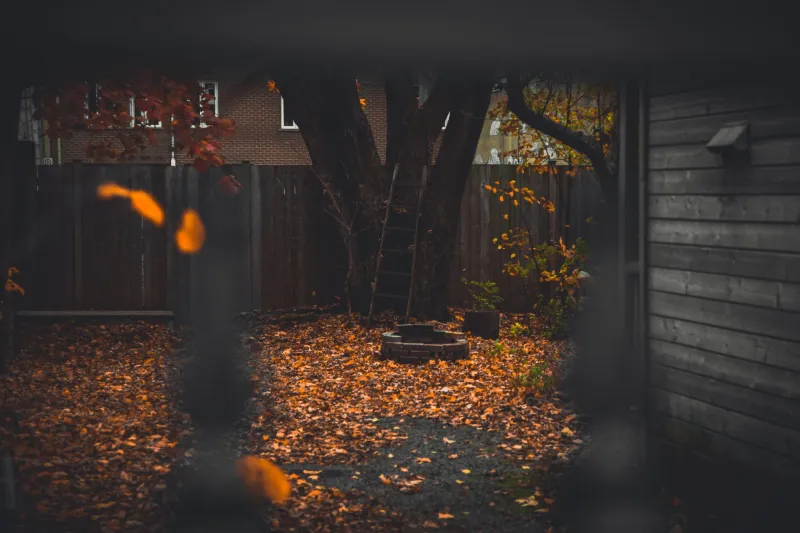
There's a particular kind of November afternoon where the sky has clearly given up and the rain has settled into a fine, needling drizzle. You look out at the garden, feel slightly smug about not needing to water anything, and put the kettle on. Nine times out of ten you're right. The tenth pot is the one that quietly dies.
Winter thirst is a strange thing to get your head around in a country that spends half the year complaining about damp. But containers don't behave like borders. A pot is a tiny, isolated world with a limited reservoir, and plenty of them sit in places the rain simply never lands.
The pots the rain never actually reaches
Think about where water falls. It comes down at an angle, it's deflected by roof edges, it bounces off walls, and it gets intercepted by whatever is growing at the top of the pot. Now think about where your pots are.
- Under the eaves. A classic. The gutter does its job beautifully and your pots stay dry for weeks. Same goes for anything tucked beneath a porch, a carport roof or an overhanging bay window.
- Hard against a wall. Especially on the sheltered side of a house or fence. The wall takes the weather and the pot sits in its shadow, protected and parched.
- Packed with evergreens. Bay, rosemary, skimmia, hebe, olive, euonymus, ivy. These keep transpiring through mild spells and windy days, losing moisture from their leaves all winter while the deciduous stuff next door is dormant and undemanding.
- Small pots and shallow bowls. Volume is everything. A 3-litre pot can go from damp to dust in a week of cold wind, whereas a half-barrel will hold on for a month.
- Terracotta and unglazed clay. Porous walls lose moisture to the air as well as to the plant. Lovely material, thirsty pot.
- Pots raised on feet with a free-draining mix. Excellent for drainage, less excellent for retention. Water in, water straight out.
Add a stiff easterly and you've got freeze-drying conditions — the wind strips moisture from leaves faster than roots can replace it, even when the ground is cold and the plant has slowed right down. That's the combination that catches people out: not a hard frost, but dry roots plus a cold wind.
Why it's thirst, not cold, that finishes them off
A plant in the ground can send roots down and sideways in search of moisture. A plant in a pot has whatever you gave it. When that runs out, the damage shows up as scorched leaf edges, dropping leaves, brown tips on evergreens and a general grey look that's easy to blame on the cold.
Frost is obvious. You can see it, you can plan for it, and there's a whole industry of fleece and cloches built around it. Drought in December is invisible until the plant is already struggling — and by the time a bay tree's leaves are curling, it's been thirsty for a while.
The Sunday finger test (and when to trust a meter)
Ignore the sky and check the pot. Once a week is plenty from November through February, and it takes about four minutes with a watering can in one hand.
- Push a finger in to the second knuckle — or further if the pot's a big one. Damp at the surface means nothing; you want to know what's happening at root level.
- Lift the pot if you can. A pot that feels suspiciously light is a pot that needs water. This is the single most reliable test there is, and it costs nothing.
- Tap the side. A dull thud is fine, a hollow ring is a warning.
- Use a moisture meter for the awkward ones. Big planters, pots behind furniture and anything you can't reach are where a simple probe earns its keep. Push it in, read it, move on. Don't leave it in permanently and don't treat the reading as gospel — it's one more opinion, not a verdict.
If it's dry, water. If it's damp, walk away. Resist the urge to give everything a token splash because it's Sunday.
Watering properly when it's cold
A few practical rules make winter watering safe rather than risky:
- Pick your moment. Mid-morning on a day when the temperature is comfortably above freezing and rising. Never water onto frozen compost or into a pot that's frozen solid — the water has nowhere to go and the roots won't thank you.
- Water slowly and thoroughly, then stop. One good soak that reaches the rootball beats five light sprinklings that only wet the top inch. Aim for a trickle, not a flood.
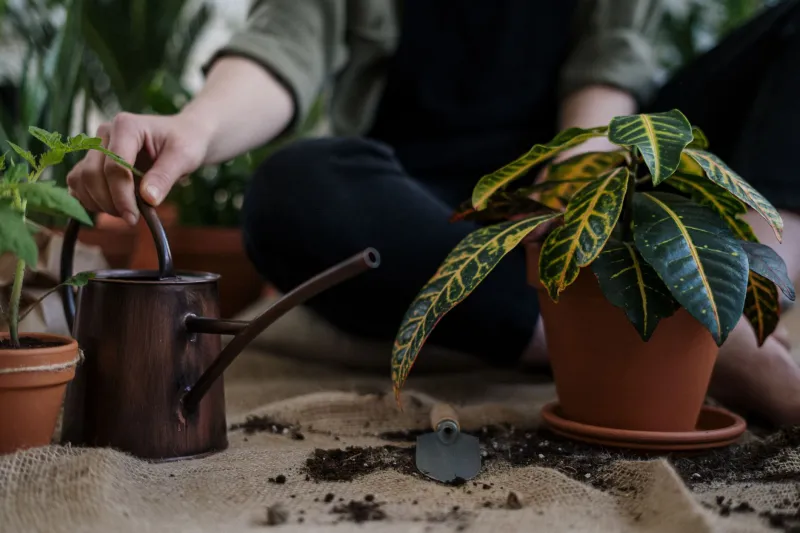
- A long-spout watering can is genuinely worth having. It reaches the back of a crowded shelf, gets under the foliage without drenching the crown, and lets you water precisely rather than hopefully. The narrow spout also helps you avoid splashing compost onto leaves and windowsills.
- Let it drain. Pots should sit on feet or blocks so surplus water escapes rather than pooling in a saucer and freezing around the base. Pot feet solve two problems at once: drainage in winter and air circulation under the pot.
- Mulch the surface. A 2–3cm layer of bark, leaf mould or gravel on top of the compost slows evaporation, insulates the roots a little and stops the surface panning and cracking. Keep it clear of stems.
- Group pots together. Clustering them creates a slightly more humid microclimate and cuts wind exposure. It also makes the weekly check a two-minute job rather than a tour of the whole garden.
A ten-minute weekly routine that actually sticks
Pick a fixed day — Sunday morning, say — and run the same circuit. Kitchen windowsill, front step, the two pots by the back door, the shelf against the fence, the big planter by the gate. Finger or lift, water if needed, done.
Keep the watering can somewhere you'll trip over it rather than in the far corner of the shed behind the strimmer. Fill it the night before if your tap water is bitterly cold, so it's at least at ambient temperature by morning. And keep a note on your phone of which pots dried out first — it'll be the same ones next week, and next winter.
The honest summary: frost gets the headlines, but in a British winter it's often a dry pot in a sheltered corner that does the damage. Check weekly, water deliberately, and your containers will come out of March looking like they were looked after — because they were.